Showing posts with label Meat. Show all posts

Wednesday, September 05, 2007

Chili chicken and cashew salad


This is the kind of dish that is sometimes called low-carb. It is low-carb, of course, but there is no such label in this blog. We love ourselves some starchy food over at beurre et pain! Potatoes, rice, pasta, bread - bring them on! Why did people suddenly start to believe that carbohydrates were making them fat? Could it be that carbs are not bad as such but that too large quantities will make you pile on the pounds? Anyhow, I'm carb-friendly which is why I think that, by all means, you should add some cold noodles to this salad if you feel so inclined.

Chili chicken and cashew salad (serves 4)
Recipe from
Cool Food, published at Murdoch Foods

  • 3 tablespoons sweet chili sauce
  • 2 tablespoons lime juice
  • 2 teaspoons fish sauce
  • 2 tablespoons chopped coriander
  • 1 garlic clove, crushed
  • 1 small red chili, finely chopped
  • 1.5 teaspoons grated fresh ginger
  • 2 tablespoons olive oil
  • 600g chicken breast fillets
  • 100g salad leaves
  • 250g cherry tomatoes, halved
  • 100g lebanese cucumber, cut into bite-sized chunks
  • 50g snow pea sprouts, trimmed
  • 80g cashew nuts, roughly chopped
Combine the chili sauce, lime juice, fish sauce, coriander, garlic, chili, ginger and 1 tablespoon of the oil in a large bowl.

Heat the remaining oil in a frying or chargrill pan over medium heat until hot, and cook the chicken for 5-8 minutes on each side or until cooked through. While still hot, slice each breast widthways into 1 cm slices and toss in the bowl with the dressing. Leave to cool slightly.

Combine the salad leaves, cherry tomatoes, cucumber chunks and snow pea sprouts in a serving bowl. Add the chicken and all of the dressing, and toss gently until the leaves are lightly coated. Scatter with the chopped cashews and serve.

P.S. I misread snow pea sprouts for snow peas. That was nice, too.

Tuesday, August 14, 2007

Bean soup with sausage, celery, carrots and tomatoes


The Boyfriend and I are moving to another city. Only in december but I'm dreading it now already. As much as I'm looking forward to living in a new place, I just find moving so unsettling. Rummaging through my kitchen cupboard the other day, I found a half-empty bag of soissons beans in a remote corner and immediately decided they had to be cooked for fear of having to pack and unpack them in a couple of months. I hear there are pulses where we are going. Apart from the beans I had some sausage that needed to be used up and that's how this meal came together. Autumn has been creeping in and this dish fits the weather perfectly.

Bean soup with sausage, celery, carrots and tomatoes (serves 2)

  • 160g of soissons beans
  • a pinch of bicarbonate of soda
  • 1 garlic clove
  • 1 large ground meat sausage
  • 2-3 celery stalks, finely chopped
  • 2 carrots, peeled and finely chopped
  • 2 tomatoes, deseeded and chopped
  • 2 teaspoons olive oil
  • 1 small dried chili, crumbled
  • salt and freshly ground pepper
  • 4 sprigs of dill, finely chopped
Soak the beans with the bicarbonate of soda in cold water over night. Drain and cook until soft. (I used my tried and tested pressure cooker and it took only ten minutes.) Blend the beans and the garlic with some of the cooking water until smooth. Pour back into the pan and season with salt and pepper. While the beans are cooking, prepare the topping. Remove the sausage meat from the casing and roll into small balls. Fry them in a large frying pan until nicely browned, then remove. Wipe the pan with kitchen paper, add the olive oil and heat gently. Add the celery and carrots and season with salt and pepper. Cover the pan and cook the vegetables until just done. Add the sausage balls, tomatoes, chili and dill and correct the seasoning. Divide the soup between two plates and top with the sausage and vegetables.

Thursday, August 02, 2007

Barley with spicy sausage and mushrooms


This is what I made the third time I cooked barley. After my intial success with the barley caprese, I got a bit cheeky and served it very simply, just seasoned with salt, pepper and a little olive oil. That didn't go down well with all the diners at my table so the next time I reached for my bag of barley, I also made sure I had some spicy sausages and mushrooms at hand to counterbalance the health food aspect of the grains. I'm a bit clever that way, don't you think?

Barley with spicy sausage and mushrooms (serves 2)

  • 120g barley
  • 1 spicy sausage, meat removed from casings
  • 150g mushrooms (possibly mixed)
  • 1 onion, finely chopped
  • 1 bunch flat-leaf parsley, chopped
  • 0.5 tablespoon olive oil
  • 1 teaspoon aged balsamic vinegar
  • salt and pepper
Cook the barley until soft. In the meantime, fry the onion in the olive oil over a moderate heat. Roll the sausage meat into little balls and add to the onions. Turn the heat up a little bit and fry for a couple of minutes. Cut the cleaned mushrooms in halves or quarters depending on their size and add them to the frying pan. Fry until most of the liquid they will release has evaporated. Add the parsley, balsamic vinegar and season with salt and pepper. Mix into the barley and serve.

Tuesday, July 24, 2007

Monday night steak wrap with peppers and avocado


I admit that I'm a bit of a health nut. At least sometimes. Wholegrains intrigue me and I could experiment endlessly. Most of the time, the Boyfriend is fine with that and I am especially delighted when he ends up liking one of my healthy concoctions as much as I do - the barley "caprese" for instance. I realise that I must not try his patience endlessly, however. For instance, I learnt that I could only administer wholewheat pasta in homeopathic doses in the combination with a generous serving of bacon. As good-natured and unfussy a eater he his, willing to try anything, some days, nothing makes him happy like a straight meat-and-two-veg dinner. Or a steak wrap with peppers and avocado on a particularly dreary and rainy monday night such as yesterday's. I got the idea from The Pioneer Woman Cooks who makes a mean steak sandwich for her Marlboro Man, only my version doesn't include butter (seeing neither the Boyfriend's nor my work involve the rounding up of cattle or similarly physically challenging activities - unless things such as typing furiously, walking to the cafeteria and removing paper jams count) and I added some vegetables other than the onions.

Steak wrap with peppers and avocado (serves 2 hungry office cowboys resp. girls)

  • 250-300g steak tenderized with a mallet , cut into strips
  • seasonings for the meat to taste (salt, pepper, tacky meat seasoning mixture)
  • 1 tablespoon olive oil
  • half an onion, finely sliced
  • one pepper, finely sliced
  • a couple of cherry tomaotes, halved
  • 2 tablespoons finely chopped parsley
  • salt and freshly ground pepper
  • 0.5 teaspoon ground cumin
  • 0.5 avocado, peeled and diced
  • 2 tablespoons lemon juice
  • mexican salsa from a jar (optional)
  • 4 corn flour tortillas
Heat the tortillas according to packet instructions. (Do this at the very end if using a microwave oven. We don't have one, believe it or not). In a large frying pan, heat half of the olive oil and gently fry the onion until soft. Add the pepper and season with salt, pepper and cumin. Fry for a few minutes until cooked but not completely soft, then add the cherry tomatoes. Cook for another minute. Cover the pan and remove from the heat. Season the meat according to taste. My steaks came in a chili marinade, so I left that out. Heat a grill pan until very hot. Add the remaining oil and fry the steak strips briefly from both sides until just done. Put a tortilla on each plate, spread with a little salsa if using, then add the vegetables and some meat. Roll up and tuck in immediately. Make sure to have plenty of napkins at hand.

Tuesday, June 12, 2007

Vietnamese pork skewers


A little while ago, out of the blue, the Boyfriend asked me whether I might be able to cook a dish he had eaten in Paris years ago, something thai maybe, or vietnamese, which consisted of meat and vegetables rolled up in lettuce leaves. Well, I most certainly could! I wanted to know more about the mystery dish but he couldn't remember much - only that it had been very tasty. After a little research, I settled on these vietnamese porks skewers which are rolled up in butter lettuce leaves with raw vegetables and rice noodles. The recipe is from a book called Street Food by Clare Ferguson. I'm not sure whether the Paris dish was anything like it but anyhow, the Boyfriend's (and my) verdict was: very good.

Vietnamese pork skewers (serves 4)

For the marinade:

  • 4 garlic cloves, minced
  • 2 tablespoons fish sauce
  • 1 tablespoon freshly squeezed lemon juice
  • 2 tablespoons sugar
  • 6 caffir lime leaves, very finely chopped
  • 20cm-long piece lemon grass stalk, finely chopped
  • 5cm-long piece ginger, finely chopped
  • 1 small chili, chopped
  • 500g pork fillet, cut into 1cm-cubes
  • 12 wooden skewers, soaked in water for thirty minutes
For the dipping sauce:
  • 1 teaspoon sugar
  • 1 tablespoon freshly squeezed lime juice
  • 3 tablespoons fish sauce
  • 1 red or green chiili, chopped
  • 5cm-long piece spring onion, green part only, finely chopped
To serve:
  • 15 butter lettuce leaves
  • 250g rice noodles, cooked (I served them warm, but cold would be fine, too)
  • 1 carrot, cut into thin sticks
  • 1/3 cucumber, cut into thin sticks
  • finely chopped herbs, such as peppermint, basil, coriander, parsely or chives
  • soy sprouts
Stir all the ingredients for the marinade together in a non-metallic bowl. Add the meat and let marinate for 20 minutes. Put 6-7 meat cubes onto each skewer and cook the meat on the grill or in a hot frying pan for four minutes until browned from all sides. Keep warm. Deglaze the residue in the pan with the remaining marinade and cook for a few minutes until it thickens. Pour over the meat.

Mix all the ingredients for the dipping sauce. To eat, place a lettuce leave on your plate, then add some noodles, vegetable sticks, meat and herbs. Don't overdo the noodles - consider yourself warned. Roll up and dip in the sauce. Messy but fun.

Sunday, April 08, 2007

Tagliatelle al ragù di vitello


A little more than a year ago, the Boyfriend and I went to Paris for a long weekend. One night, we had the most delectable dinner in a tiny italian restaurant in Rue Tiquetonne, not so far from Forum des Halles. I can't remember the name of the restaurant nor what I had but I have a very clear memory of the Boyfriend's primo: a plate of tagliatelle coated in a silky-smooth ragù. I tried to make a similar dish here but added a little tomato, while there was none in the Paris version, which might actually have been made in broth which was then used to make the sauce, a bit like a very light béchamel. I'll give it a little more thought and try it another time.

Tagliatelle al ragù di vitello (serves 4)

  • 1 tablespoon olive oil
  • one large onion, finely chopped
  • 1 garlic clove, finely chopped
  • 2-3 carrots, peeled and very finely diced
  • 2 stalks of celery, equally finely diced
  • 2 tablespoons tomato purée
  • 400g ground veal
  • 3 dl dry white wine
  • 3 tablespoons italian parsley, chopped
  • salt and pepper
  • 500g fresh tagliatelle or pappardelle
Heat the olive oil in a large, deep frying pan. Add the onions and garlic and fry over a low heat until the onions are soft. Add the carrots and celery and fry for another few minutes. Turn up the heat, then add the meat. Fry for five minutes, then stir in the tomato purée. Season with salt and pepper. Add the wine and let evaporate a bit, then cover the pan and simmer the sauce for about fifteen to twenty minutes, adding the chopped parsley for the last five minutes. Check the seasoning. Cook the pasta, drain and add to the sauce. Mix carefully. Serve in deep plates with grated parmesan and freshly ground black pepper. Perfect for the first warm days of spring.

Sunday, January 21, 2007

Bucatini calabrese


Before the italian cooking savvy start a rant about me calling this dish calabrese, I admit: there is nothing traditionally calabrese about it whatsoever. But please, let me explain. It's all about the sundried tomatoes. Not just any sundried tomatoes, oh, no - the ones I used, ladies and gentlemen, were directly imported from Calabria, where P.'s parents got them while on holiday last summer. I've had the jar for a while now and, P., in case you wondered sometimes, I hadn't forgotten about it. The thing is, there was also a jar of store-bought sundried tomatoes to be used up and, more importantly, I had to think carefully about what to make with the original calabrese ones as I consider them to be too precious to be just casually used without giving it any deep thought. Here's what I came up with:

Bucatini with lamb tenderloin and sundried tomatoes (serves 2)

  • 120g bucatini or spaghetti
  • 1 onion, finely chopped
  • 1 garlic clove, finely chopped
  • 10 sundried tomatoes, drained and chopped
  • 1 large handfull of flat-leafed parsley, chopped
  • 1 small glass of dry white wine
  • 300g lamb tenderloin
  • salt and pepper
  • 1 tablespoons olive oil
Preheat the oven to 80° and heat an ovenproof dish. Season the meat with salt and pepper. Heat the olive oil in a frying pan, then fry the meat from all sides for six minutes in total. Immediately transfer into the preheated dish in the oven and leave in there for 30 minutes. Add the onions and garlic to the frying pan and cook over a low heat until softened. Add the sundried tomatoes and parsley and cook for a few minutes. Add the white wine and let it evaporate a bit. Season with a little black pepper. While the sauce is cooking, prepare the pasta, then drain and mix with the tomatoes. Remove the meat from the oven, cut into thick slices and arrange on the pasta. Serve with a little grated parmesan if you like.

Just a word about the tomatoes: they were amazing. They tasted of tomatoes and nothing but tomatoes (and the sun of southern Italy, I might say, but that's so clichéd, so I won't), none of those funny little side-tastes you sometimes get in store-bought sott'olio goods. The onion, garlic and parsley made for a nice addition without distracting from the main protagonist. Nice. Thank you, P.!

Wednesday, December 20, 2006

Poached chicken in creamy morel sauce


In my mind, I have already poached many chickens. I've always loved the thought of doing it, gently simmering a chicken until the tender meat just falls from the bones and the broth is fragrant and tasty, sporting little dots of chicken fat on the surface. There seems something so grown-up about it - the hand that poaches the chicken is the hand that rules the kitchen. Or something like that. Well, I finally did it for real. Man, it was good (both the process and the result) - what took me so long, I wonder? Having a lot of time on hand, I made a recipe I had been lusting over for ages:

Poached chicken in creamy morel sauce (serves 4)

  • one largish chicken
  • 2 carrots
  • 1 small leek
  • half a celeriac
  • half an onion
  • one bay leaf
  • 2 cloves
  • one chicken stock cube
  • 25g dried morels
  • 1 shallot
  • 50g butter
  • 2 tablespoons flour
  • 200 ml white wine
  • 200 ml single cream
  • salt and pepper to taste
Wash the chicken inside and out and pat try. Peel the vegetables and cut into chunks. Attach the bay leaf to the onion with the cloves. Place everything in a large pot and add water until the chicken is covered. Bring to a boil. Skim the broth once or twice at the beginning, then add the stock cube. Cover and simmer for about 50 minutes. Remove the chicken and let cool slightly. Set 300ml of the broth aside. Skin the chicken and remove all the meat from the bones. Set aside. Soak the morels in warm water for 30 minutes. Drain and rinse well to remove dirt. Cut large morels in halves or quarters. Heat 25g butter in a large saucepan then sauté the shallots and the morels, stirring frequently, for 5 minutes. Remove from the pan. Melt the remaining butter, then add the flour and stir until there are no more lumps. When the mixture is bubbling, add the broth and white wine, stirring well. Cook for 5 minutes, then add the cream and morels and cook for another five minutes. Season with salt and pepper. Add the meat and heat through.

Friday, November 24, 2006

Rustic fare


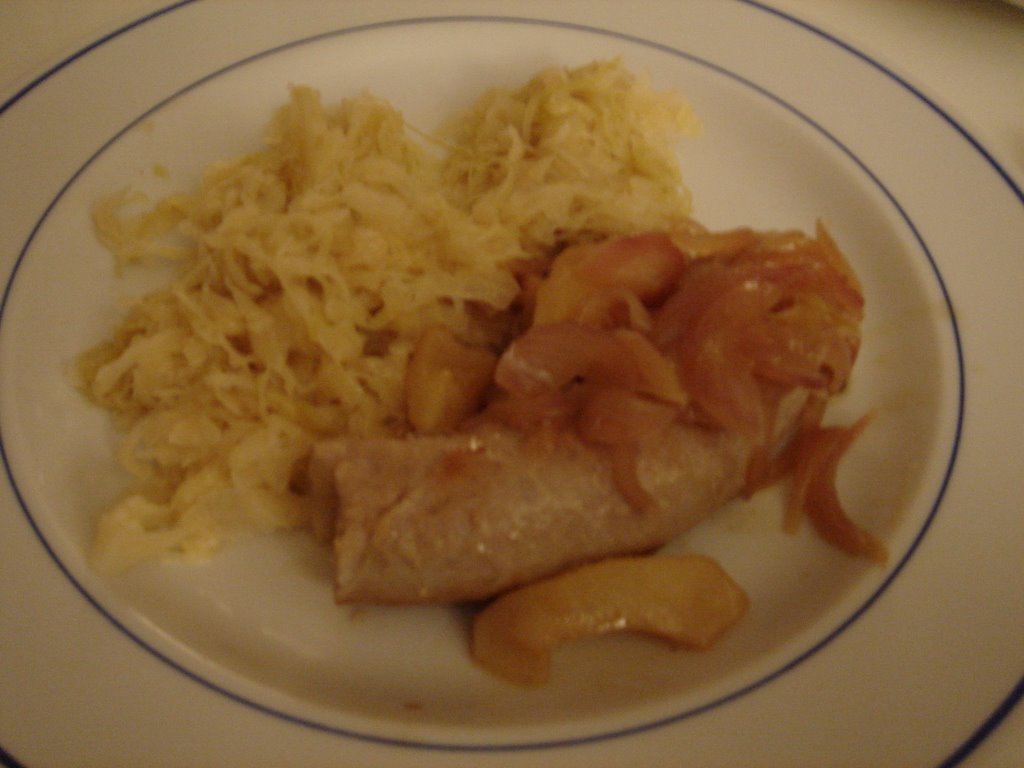
As much as I adore to try all kinds of more or less exotic dishes I once in a while resort to a true swiss classic. Tried and tested, those dishes never fail to please. And the Boyfriend certainly enjoys a "normal" dinner now and then, such as

Bratwurst with onion and white wine sauce (serves 2)

  • Some good-quality ground meat sausage
  • some oil for frying
  • 2 red onions, cut into fine slices
  • one small apple, peeled and cut into chunks
  • 1 dash of curry powder
  • one glass white wine
  • salt and pepper
Heat the oil in a large frying pan and fry the sausage until nicely browned on all sides. Add the onions to the pan and fry them over a low heat, stirring frequently until softened and browned. Add the apple and curry powder, fry for another minute, season with salt and pepper, then add the white wine. Cover the pan and cook everything over a low heat until the onions and the apple are very soft. Serve with sauerkraut and bread. Or mashed potato if you think your stomach might be overwhelmed with onions and sauerkraut.

In case you wonder why there is curry powder in a traditional swiss recipe - there wouldn't be, that's just me. And the apple isn' t traditional either. There is nothing I can say in my defence.

Friday, November 03, 2006

Paris for less


Have you been to Paris lately? No? Me neither. And I don't think I will be going anytime soon. But this post's dish always seems to me like proper parisian bistrot food. (Its' not actually, I made it up, but never mind that). A little french touch, to be whipped up in the realm of your own kitchen. That's something, isn't it?

Loin of lamb with mustard and vermouth sauce (serves two)

  • 300g loin of lamb
  • some oil for frying
  • salt and pepper
  • 1 dl dry vermouth
  • two heaped tablespoons moutarde à l'ancienne (the one with the grains)
  • 2 tablespoons sour cream
Turn the oven on (90°) and preheat a oven-proof dish for the meat and the plates you want to use. Season the meat with salt and pepper and fry in the hot oil for about ten minutes until nicely browned on all sides. Place the meat on the preheated dish and put in the oven for about thirty minutes. Add the vermouth to the frying pan and simmer for a while, scraping at the bottom of the pan in order to dissolve the residue left by the meat. Then add the mustard and sour cream and simmer a little longer until the sauce thickens. Season with pepper and set aside until the meat is done, then reheat. Cut the meat into thick slices and arrange on the warmed plates, then drizzle with the sauce. Serve with mashed potatoes and some greens; we had green beans with a little grated lemon zest, olive oil and sea salt.
Bon appétit!

Wednesday, September 27, 2006

Pasta al forno


Last thursday morning I called my parents and spontaneously invited them to dinner on friday night. Sometime in the afternoon it dawned on me that I might have to prepare something in advance as I was going to get home at half past six on friday evening and I had told them to come at seven. Uh-oh. I had to be realistic as to what I could make in the little time I had but I didn't want something that screams "I had no time". My parents love good food and my mother is a fabulous cook so I also wanted to suprise them just a little bit and not rely on one of my staple dishes. I was pondering all kinds of pasta-variations and finally settled on pasta al forno (oven-baked pasta). There are many ways of making this and I love them all, there is something so genuine and comforting about a dish of hearty pasta with a delicious crust of melted cheese. I made mine with a beef stew which I could prepare the night before. It's worth making this in a large quantity, you can always freeze some of the stew and use it another time. I used the pressure cooker to speed up the cooking of the stew, which is a very unorthodox way of proceeding. Ideally, the stew would be simmered for several hours until the meat is tender but this is 2006 and pressure cookers are the working population's best friends.

Pasta al forno (serves 4 hungry guests)

- 600g beef, any cut suited for braising, in 2cm-cubes
- 1 small handfull of bacon cubes or strips
- 1 onion, finely chopped
- 2 teaspoons dried herbs such as rosemary, thyme and oregano
- about 400g canned chopped tomatoes (now you see where they went)
- a few lugs of red wine
- 2 tablespoons olive oil
- 20g dried porcini mushrooms, soaked in hot water
- 360g maccheroni or another type of short pasta
- grated parmesan

Heat the olive oil in the pressure cooker and fry the beef cubes in batches until nicely browned. Season with salt and pepper and set aside. Fry the onion and bacon for a few minutes, stirring frequently. Add the herbs and fry for another minute. Return the meat to the pan, add the tomatoes and the wine. Bring to a boil, put the lid on and cook for about 1 hour (on the higher setting of your pressure cooker). Then add the porcini mushrooms and simmer uncovered in order for the sauce to thicken a little bit (it will be quite thin as hardly any liquid evaporates in the pressure cooker). Season with pepper and a little salt, depending on how salty your bacon was. Cook the pasta until just al dente, drain and return to the pan. Mix in about 2/3 of the beef stew and put everything into a gratin dish. Top with the rest of the stew and sprinkle generously with grated parmesan. Bake in the preheated oven (200°) until the cheese has melted and forms a brown crust.

Be careful when using a heavily marbled cut of beef, you may want to leave out the bacon or the sauce might become to greasy. However, if you use a lean cut as I did, the bacon will add dephth to the flavour.

Saturday, September 23, 2006

Guest star


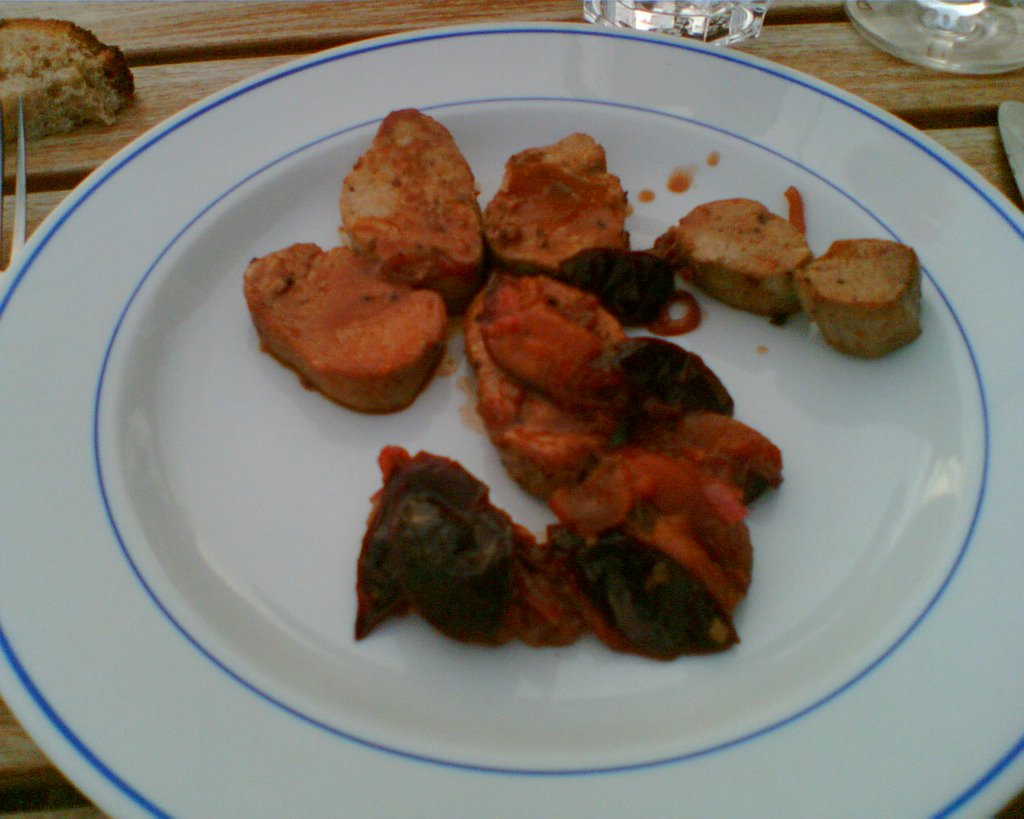
This is a first: the dish I'm writing about is not one I made myself. The Boyfriend made it. Friends sometimes ask us whether we take turns in cooking. Actually, we don't. Not because of some traditional role model we cling to or because the Boyfriend can't cook, nothing like that. It's just - I love cooking so much that I happily do it every day. It's a good thing the Boyfriend a) loves to eat and b) is not that wild about cooking himself. One day a few weeks ago, however, I was running late so he offered to cook whatever I had had in mind for that evening. With a few instructions from me given over the cell phone and the recipe ripped out of another glossy, he made the most amazing

Pork tenderloin with plums and port (serves 2)

You'll need:
- 300-350g pork tenderloin, cut into medallions
- 1 tablespoon olive oil
- 1 red onion, finely sliced
- 8-10 plums, halved
- salt and pepper
- 1.5 dl port (tawny port, the dark, sweet kind)
- a few tablespoon chicken stock (optional)

Put a small gratin dish into the oven and preheat to 80°. If there is space, put in the plates you will use as well. Heat the olive oil in lidded frying pan and fry the pork medallions from both sides over a medium heat until browned. Season with salt and pepper and keep warm in the preheated dish in the oven. Add the onion to the pan and cook over gentle heat until softened, stirring as it cooks. You might want to add a tablespoon of water in order to dissolve the sediment left by the meat. Add the plums to the onion and cook for five minutes over a low heat, covered. Return the meat to the pan, adding the juice that might have been released and check the seasoning, maybe add some more salt and pepper. Increase the heat to medium hot , add the port and simmer for two minutes. Add some stock if you think there's too little sauce.

We had this with just a slice of bread as we had had a substantial starter as well but you could serve this with rice or maybe mashed potatoes (said the Boyfriend).

The original recipe (which I had ripped out of a copy of Zest - all about fitness and dieting but with great recipes in every issue!) used pears and sweet sherry. The strong-tasting pork can take the sweet stickyness of the fruit and the port or sherry. Figs would work, too, I think.

As much as I like to take charge in the kitchen, I really enjoyed having a guest star for a change. I shall remember to run late once in a while.

Friday, September 08, 2006

Polpette al sugo


Once upon a time, there was a restaurant called Paradosso where I live. You could sit in the romantic garden or the simply furnished, yet elegant dining room and enjoy the most delightful italian food. Everything they served was finger-licking good, but I have particularly fond memories of their meatballs which were authentically announced as polpette al sugo by the staff. Sadly, the Paradosso closed down a few years ago and I forgot about the meat balls. Until I was so lucky to taste the ones P., peanut-bee's boyfriend made in when I visisted them in Berlin. He served them as a main course after a primo of spaghetti with home-made pesto, with crusty ciabatta to mop up the sauce. Peanut-bee and her boyfriend are nowhere near as obsessed with food and cooking as I am, but they are both wonderful cooks who can whip up the most delectable food without consulting five different cookbooks first. The Berlin dinner (including the zabaione al marsala served for dessert) was some kind of culinary golden section, a completely harmonious composition of flavours and textures, perfect in its simplicity. The kind of meal that prompts me to make a mental note to remember that sometimes less is more and never to forget about meatballs again. I didn't and even made them myself the other day.

They are quite a lot of work so I made a large quantity and froze the leftovers. (First, I made a simple tomato sauce with onions sautéd in olive oil and one large bottle of passata and left it to simmer while I prepared the meat). For the polpette, I used:

- 600g mincemeat (mixed in my case: pork, veal and beef)
- 4 slices toast, crust cut off
- 1 bunch flat-leaf parsley, finely chopped
- 1 large onion, finely chopped
- olive oil
- 3 tablespoons breadcrumbs
- 1 egg
- 2-3 tablespoons flour
- salt and pepper

Soak the bread in warm water for a few minutes, then squeeze out the excess moisture and mush up with a fork. Fry the onion and parsley in a little olive oil until the onions are soft. Add all the ingredients to the mincemeat and mix thoroughly with your hands (this is my favourite part). Add more breadcrumbs if the mixture seems too wet. (At this stage, I fried up a tiny bit of meat to check the seasoning knowing about my tendency to be a bit too cautious with the salt.) Form smallish balls with your hands and roll them in a little flour. Put on a plate and chill for at least an hour. Heat the olive oil in a large frying pan and brown the meatballs in batches from all sides over a medium heat for a few minutes. Drain on kitchen paper, then place in the tomato sauce and simmer very gently for about thirty minutes.

Serve with pasta or just crusty white bread. Ecco - comfort food all'italiana!

Monday, August 28, 2006

Mango Chicken Curry


My mango chicken curry is adapted from a recipe featured in Jody Vassallo's Easy Curries, which I recommend highly if you, like me, are a curry-lover. The recipes are accurate and not too fussy and many of them, like the mango chicken curry, can be thrown together in just a few minutes. I especially love creamy curries made with coconut milk, but I find that in restaurants, they are often extremly greasy. When you make them at home, you can get the silky richness without the heavy feeling that sometimes sets in after a meal at Thai restaurants.

For the two of us, I used:

- 1 tablespoon olive oil
- 2 spring onions, stalks only, finely chopped
- 1 tablespoon panang curry paste (a thick paste containing chilies, ground peanuts, garlic and many other spices)
- 300g chicken breast, cut into 2cm-wide strips
- half a mango, cut into chunks roughly the size of the chicken
- 1 tablespoon chopped flat-leaf parsley
- 1.25dl coconut milk
- 0.5 dl water
- juice of half a lemon or lime
- 2 teaspoons fish sauce
- 1 tablespoon sweet chili sauce
- a couple of basil leaves, chopped (use thai basil if you like)

- heat the olive oil in a large frying pan, add the panang curry paste and fry for a few minutes over moderate heat
- season the chicken pieces with a little salt, then add them to the pan together with the spring onions and fry for about three minutes, stirring occasionnally
- add the mango and parsley, fry for another minute, stirring carefully
- add the coconut milk and water, cover and simmer for five minutes
- season with lemon or lime juice, fish sauce and sweet chili sauce
- sprinkle with the basil and serve

You could make the curry paste yourself if you're ambitious. If you're not, (ts, ts) buy it from a supermarket or Asia shop (like I did).

Jody Vassallo's recipe asks for red curry paste but I quite like the combination of the mango and panang paste. The fruit adds a very pleasant freshness to the rich, earthy taste of the peanuts.

Also, a whole mango is used in the original recipe which makes for a very fruity curry. I use less mango and a little more chicken instead. The Boyfriend actually suggested not to add any mango at all, but that's hardly the point in a mango chicken curry, is it? Men.